Why Did the Confederacy Become Popular Again
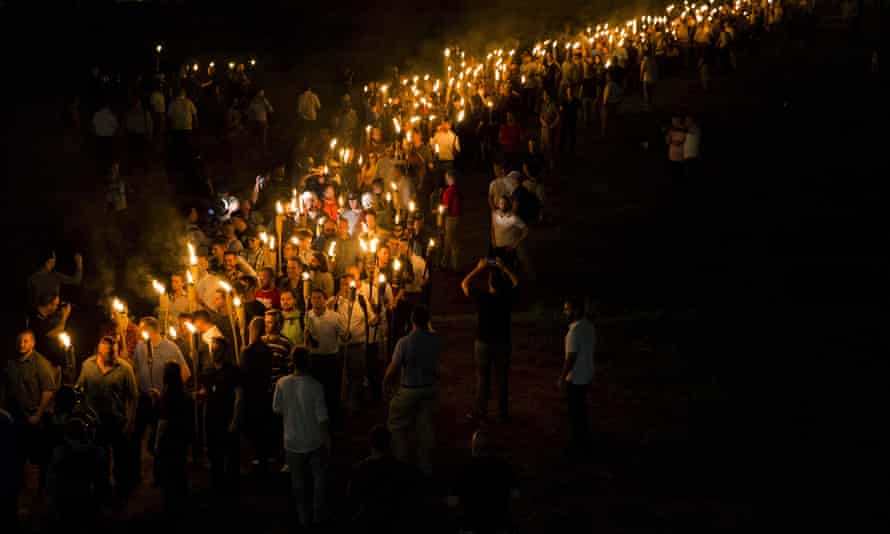
I n St Paul's memorial church in Charlottesville, Virginia, final Friday, just up the street from where white supremacists were gathering for a torchlight rally, Cornel West explained why African Americans saw the removal of Confederate monuments equally and then important.
On hearing that hundreds of white supremacists were gathered in a nearby park, the civil rights leader said, with a hint of weariness: "These are chickens coming home to roost. We should have eliminated these statues a long time agone.
"The idea that the American family has to embrace figures like [Confederate general] Robert E Lee, or Stonewall Jackson, who were fundamentally committed to enslaving black people in perpetuity … These people are not heroes."
But figures such as Lee and Jackson are heroes to some. Their admirers include Donald Trump. In a rowdy press briefing on Tuesday, he compared them to celebrated figures in American history such equally presidents George Washington and Thomas Jefferson. Their admirers as well include the white nationalist movement, which is currently surging in the US. The footsoldiers of that movement terrorised Charlottesville last weekend. Trump downplayed their trigger-happy excesses, proverb they were merely "there to protest the taking down the statue of Robert E Lee".
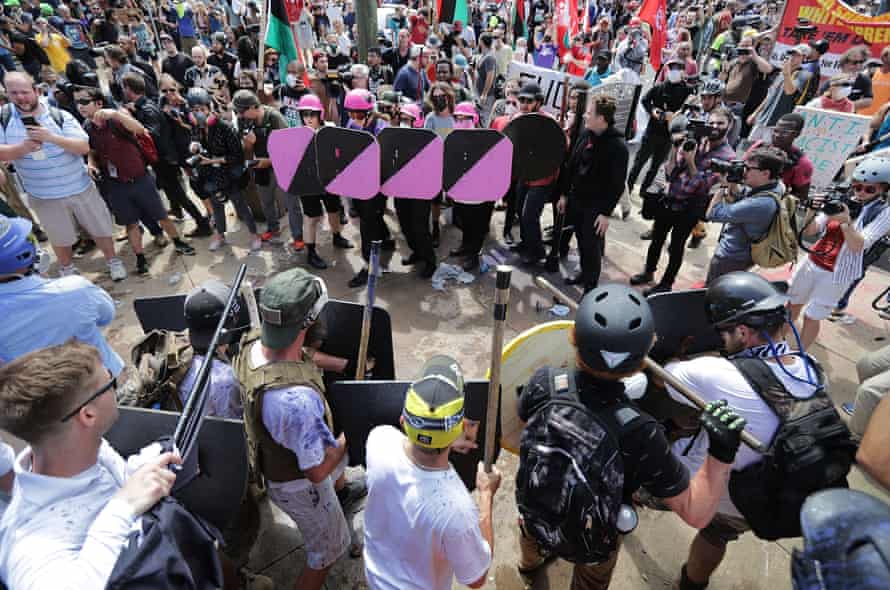
The day later on the torchlight parade, a rally featuring hundreds of more often than not young men in various states of paramilitary attire close the city down. Hours later, i of their number allegedly murdered a counter-protester with his automobile. The adjacent solar day, a planned memorial to the young woman who had been killed was close downwardly subsequently "credible threats" from white nationalists.
Their stated purpose in coming to the city for the "unite the right" rally was to contest the removal of a statue of Lee from a downtown park. In the blizzard of online agitprop that "alt right" groups circulated earlier the result, the claim was ofttimes made that in rallying around the statue they were protecting "white heritage".
Only how did monuments to the losing side in America'south civil war become such an intense focus for a national white-supremacist move? And what is the heritage they really represent?
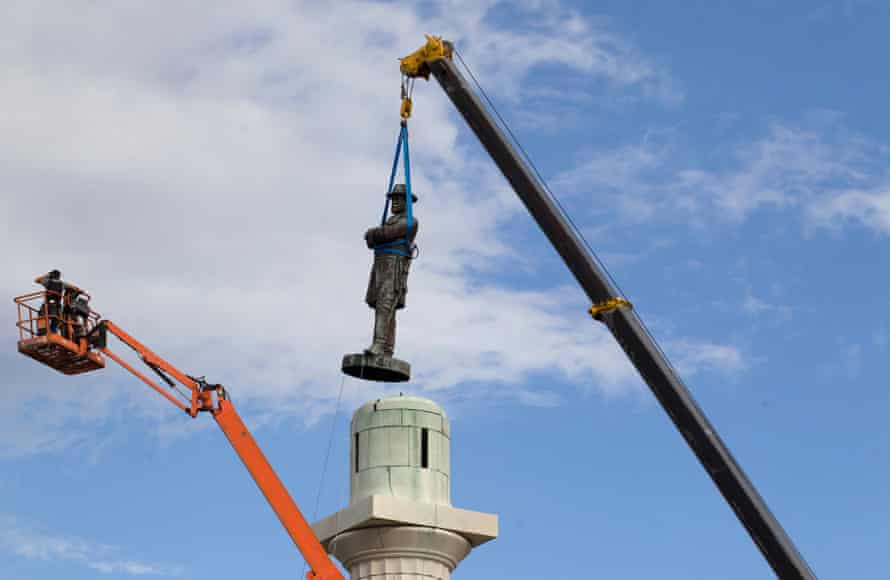
Charlottesville's statue of Lee is one of well-nigh 1,500 such monuments to the Confederacy scattered throughout the U.s.. Mostly, though not exclusively, those statues can exist institute in those southern states that broke from the union in 1861 over their desire to retain the system of slavery. In 1865, after the loss of more than 600,000 lives and the destruction of entire cities such equally Atlanta, the southern Confederacy was defeated, and slavery was abolished.
But like near of the other monuments to the confederacy'south "lost crusade", the statue in Charlottesville was non built in the immediate backwash of that war. Rather, it was commissioned more than than one-half a century later in 1917, and erected in 1924.
It was function of a moving ridge of statue-building in the due south that took place between the late 1890s and 1920, co-ordinate to inquiry from the Southern Poverty Law Eye. That wave crested in well-nigh 1911.
At that place was another, afterward, flurry of statue-building in the 50s, and effectually this time the Confederate battle flag became a popular symbol. In that decade and the next, some southern states, such as Florida, changed their flags to more than closely resemble the standard of southern defeat.
According to Joseph Lowndes, a political scientist at the University of Oregon and author of two books on the Usa'due south racial politics and the south, the timing of these enthusiasms is not adventitious. "The statues get up in moments of racial reaction."
The before craze was the moment when Lowndes says, "the Jim Crow order was actually being built in the due south". Then-chosen Jim Crow laws formally segregated public schools, public transport and public spaces more often than not in former confederate states. Laws mandated that black people and white people use separate restaurants, toilets and drinking fountains.
According to Lowndes, the Jim Crow phenomenon was a reaction to the inroads made by the populist movement, which had fleetingly created political alliances of poor blacks and whites against the rich southern planter class.
Lowndes says that southern elites sought to "accept blacks out of the electorate and segregate public space" in society to "redivide the black and white core" of the southward'due south working class and small farmers. The monuments were besides elements of this divide-and-dominion strategy. They were ultimately built for a white audience, as "elements of a culture that directed whites towards beliefs that aligned them with the planters", says Lowndes. "It was a political projection. Whatsoever political project requires symbols, and an imaginary."
Ane of the cadre beliefs at the eye of the Jim Crow project – and which these laws sought to implant – was that the civil war had not been an ignominious defeat, but a noble struggle. Leonard Zeskind, activist and author of Blood and Politics, a history of white nationalism in the US, says the purpose of the hundreds of statues erected effectually the plough of the century was "to rewrite who won the war", in order to justify Jim Crow.
Lowndes says it was in part an effort to "whitewash the civil state of war, and the reasons it was fought". Eventually, Jim Crow was dealt a blow by the supreme courtroom'south 1954 finding, in Brown v Board of Educational activity, that segregation in public schools was unconstitutional. From this fourth dimension, a blackness-led civil rights movement fought to extend the implications of this determination into the full desegregation of the due south, and carried the fight into other areas such as voting rights.
Just many whites in the s, and their state and local governments, fought molar and blast to preserve segregation. They were, in effect, fighting the civil state of war all again. In Virginia, a strategy of "massive resistance" devised by Senator Harry F Byrd Sr saw integrated schools defunded and schools airtight, including in Charlottesville.
It was during this white resistance to civil rights that confederate symbols and statues once again became popular, and were adopted both by ordinary people and whole states, as signifiers of the resilience of white supremacy. And it was during this time that there was some other surge in the number of statues erected throughout the southern states.
Lowndes says: "They are presented as beingness office of a continuous heritage, just the idea that these symbols have annihilation to exercise with annihilation but racial reaction is wrong."
Not everyone agrees with this assessment – in particular, contemporary white Americans. Co-ordinate to the American Values Survey past not-for-turn a profit polling organisation PRRI, effectually seven in ten working-grade whites believe that the flag is a symbol of "southern pride" rather than "racism". Sixty percent of whites of all classes feel this way, and and so exercise 51% of Americans as a whole – whereas 80% of blackness Americans say it is a racist symbol, and information technology is African Americans fighting for racial justice who have been the foremost critics of confederate symbols since they were erected.
The great African American intellectual WEB DuBois wrote in 1931 of the grandiose inscriptions on recently erected monuments to the confederacy that: "Of grade, the evidently truth of the matter would be an inscription something like this: 'Sacred to the memory of those who fought to Perpetuate Human being Slavery.'" Later on, Zeskind says, "the memorials started to get questioned in the 1960s in the fight against Jim Crow, and its been pretty much going ever since".
Since the 2015 massacre of ix African American churchgoers by Dylann Roof in Charleston, S Carolina, there has been a renewed focus on the persistence of amalgamated monuments and symbols in southern cities from racial justice advocates, including the Black Lives Matter movement. In the wake of the Charleston murders, South Carolina'south then governor, Nikki Haley, ordered the removal of the confederate flag from the grounds of the land house in Columbia. But racial justice advocates want to become further by removing all confederate relics from southern cities.
In Charlottesville on Fri, local Black Lives Matter chapter member Lisa Woolfork explained that for her and her fellow activists, "these statues themselves are revisionist histories. They hide history. They tell a story from the 1920s of the 'lost cause'. It's a style of making the slave-belongings southward feel like they won."
Simply while critics of the statues have been mobilising, white nationalists have been turning the statues into rallying points for resistance to multiculturalism, feminism and minority rights. For them the fight never really stopped, and now it goes on as they rally effectually these symbols of the confederacy.
Lowndes says that: "These were largely regional sites equally late as the 1990s," of interest mostly to southern heritage groups, simply also to more extremist "neoconfederate" groups such as the Quango of Conservative Citizens, and the League of the Due south. (Neoconfederates generally desire the restoration of segregation every bit a thing of law, and some, such every bit the League of the South, even want the old confederacy to once again secede.) "But they have now become national sites for a racist rightwing movement. They allow people to feel embattled. You tin rally people to a terminal defense force."
Alexander Reid Ross is a lecturer at Portland Land University, and writer of Against the Fascist Creep, a broad historical survey of fascist movements to the nowadays. He agrees that confederate monuments have at once given the "alt-right" a convenient set of symbols to organise around, and too swelled the constituency for radical neoconfederate groups.
"Five or 10 years agone," Ross says, "there wasn't fifty-fifty a big regional constituency for neoconfederates. Simply the increase in college organising by the 'alt-correct' and neo-Nazi groups has given them a new base."
The alleged murderer in Charlottesville concluding Saturday, James Fields Jr, was himself a member of a group, Vanguard America, that explicitly targets college-age men in its recruiting, and hundreds of immature men were active participants in the weekend's events. The spectacle in Charlottesville of the League of the South marching alongside neo-fascist and neo-Nazi organisations such as Vanguard America, the Traditionalist Workers Party and the National Socialist Movement demonstrates that to some extent, their objectives have fused.
Ross says that confederate monuments are attractive to these groups partly considering they represent a period of unquestioned white supremacy. "The civil war is seen as the last stand of a proper, gentlemanly white tradition." Simply they likewise have value in terms of movement strategy. He compares their selection of the Lee monument in Charlottesville to the "patriot movement"-inspired occupation of the Malheur national wild fauna refuge in Oregon in 2016. "Y'all place an insurrectionary point somewhere and have people rally around information technology."
George Hawley, a political scientist at the University of Alabama, and author of 2 books that examine dissident rightwing movements, says that national far-right movements take been attracted to the fight over Charlottesville's monument partly from "opportunism, and a desire for controversy ... But information technology as well comes from their sincere feeling that attacks on confederate monuments are attacks on whiteness, per se."
He says that the discussion around confederate monuments is indicative of the growing estrangement between a resurgent radical right, and an embattled mainstream conservatism. In the past, he says, "mainstream conservative media outlets were supportive of the maintenance of confederate symbols", and did and so under catchphrases such as "heritage, not hate". This changed after Roof's rampage in Charleston: establishment and and then-called "movement" conservatives "stopped defending monuments".
On the other hand, over the same 2 years, passionate defenders of confederate symbols began "echoing the progressive critique of the monuments", offering "a more radical pushback confronting the idea that it wasn't about race". From "heritage non detest", so, some moved to the access that their heritage was hate.
This was perfectly timed with the ascension of the "alt-correct". Like that broader white nationalist move, they sought to get out behind the "dog-whistling", coded talk about race that Republicans had been honing since Nixon realigned the southward's politics with his "southern strategy", and openly push white supremacy.
Southern politicians in communities polarised around disputes over monuments sometimes try to equivocate. During the debate over the statue of General Lee in Charlottesville, Mayor Mike Signer suggested that instead of removing such statues, they could be "contextualised" with plaques or installations explaining the civil war and the reasons it was fought.
Woolfork, the Black Lives Matter activist, disagrees. "In that location is no better context for these statues than the hundreds of white nationalists coming to defend them." She says they need to go, considering "yous cannot tell beautiful lies about ugly stories".
In that location have been signs in the days since that the events in Charlottesville may take only accelerated the motion against confederate statues. In Durham, Due north Carolina, a group of protesters pulled downwards a monument dedicated in 1924. On Tuesday night in Baltimore, hours after Trump's incendiary press conference, the city removed iv confederate memorials, including one of Robert E Lee and Stonewall Jackson. Other cities take committed to tearing statues downwardly since the weekend.
For Cornel West, the sooner the amend. Every bit the white nationalist torchlight rally prepared to kick off non a mile away, he said that the heritage the statues speak for is not worth commemorating. "The confederacy is role of a tradition that's grounded in hatred, and is tied to one of the most roughshod structures of domination in the modern world."
Afterwards the weekend's events, it may be that more of the white Americans who consider these symbols a matter of "pride" come up to see his point.
constablelesellizen66.blogspot.com
Source: https://www.theguardian.com/world/2017/aug/16/why-is-the-us-still-fighting-the-civil-war
0 Response to "Why Did the Confederacy Become Popular Again"
Post a Comment